

CAIRN FERTILITY:
IVF SUPPORT PLATFORM PRODUCT DESIGN
Secondary Research, ResOps/ Generative Research, Proof of Concept Prototype
with Figma Make,
Figma Prototype
Project Overview
This independent, self-directed UX research and design project explored the experiences of women who are currently facing infertility and undergoing IVF (or went through the process within the last 1-3 years). It examined how they felt supported or unsupported throughout their journey. The study focused on the challenges they experienced and what tools and resources women used for emotional, practical, medical and mental health support.
Drawing from both my professional background in healthcare research and my own personal experience undergoing IVF in the last year, I set out to better understand the lived experience of infertility. The ultimate goal of this project was to design a vision for a better support platform that serves women experiencing the isolating journey of infertility.
The end product is titled "Cairn Fertility." Concept development is detailed in the case study below. This project was conducted while I engaged in AI product design coursework during the summer of 2026 with Design Lab.
This case study below provides an transparent overview of each step in my project process, including key deliverables and artifacts.
Methodology
This research and design project involved a mixed methods approach, including the following methods and phases:
-
Research brief development, project roadmapping and a lawyer-developed consent form to use for generative interviews - this was important for keeping myself on track for the project, maintaining participant privacy and building trust.
-
Light secondary research using peer-reviewed articles on topics related to infertility, support that women need and key pain points/challenges women face. This research review helped me to identify known themes and begin to frame the problems facing women.
-
Competitive analysis including a feature comparison matrix of four main competitors: Carousel Fertility, Conceive, Tilly and Berry Fertility. This analysis determined gaps in current products and where they failed to meet the needs of women. It also helped me understand key opportunity areas for my future product. Overall, it helped me analyze how well these current products support or do not support the fertility journey.
-
Full research operations (participant recruitment/screening, management and communications) + generative research: 7, 60-minute in-depth interviews with women who experienced trouble conceiving in the last 3 years and underwent IVF. This primary research helped me deeply understand the lived experience of women undergoing IVF and struggling with infertility, informing key problems to solve with a future solution.
-
Top insights from the research and ideation to generate feature ideas to support women, grounded in those key insights. This includes a full feature list.
-
AI-assisted concept development of Cairn Fertility for a logo, color palette and mission statement.
-
AI-assisted journey map displaying ideal state of new product with a fictional character named "Amanda," this section includes a scenario.
-
Design brief - acting as a comprehensive input for AI prototyping prompt within Figma Make, outlining opportunities, target user and scenario, MVP features to build to demonstrate Cairn's capacity and user experience, constraints, brand color palette, and priority screen requirements.
-
Proof of concept MVP prototype using Figma Make and a comprehensive design brief input as prompt. This version only includes high priority features to demonstrate Cairn's basic capacity for women undergoing IVF.
-
Figma Prototype - this was necessary to make manual edits to content after AI generation of the initial prototype.
-
Ideal Next Steps & Limitations - included at the end of this case study, as a reflection of what I would do with more budget and time.
-
Impact - including at the end of the case study to illustrate the power of this research project for both participants and the researcher.
Tools Utilized
-
Roadmapping: Google Suite (sheets, docs, forms, gmail)
-
Research Brief Generation: Claude
-
Consent Form: Matchstick Legal support
-
AI Project Workspace: Claude
-
Competitive Research: Product sites and ChatGPT
-
Secondary Research: Google, Chat GPT, University of Baltimore digital library
-
Scheduling: Calendly
-
Recruitment Sources: Facebook infertility groups, LinkedIn, personal network
-
Video conferencing: Zoom
-
Note Taking and Synthesis: Miro, Miro AI, ChatGPT, Claude
-
Image Generation including Cairn Fertility logo: ChatGPT
-
AI Journey Mapping: Claude
-
Design Brief Generation: Claude
-
Proof of Concept Prototype: Figma Make

STEP 1: PROJECT PREP
Project Planning
First, I wrote a research brief for myself, with particular emphasis on AI tool usage, including the following information:
-
Project Context and Methodology
-
Research Hypotheses (note - these were added after the secondary research review)
-
Research Questions (note - these were refined after the secondary research review)
-
AI Stack Rationale
-
Ethics and Source Validation Policy for AI Usage
Development and Lawyer Consult
To prepare for the project, I consulted with a lawyer at Matchstick Legal who specializes in working with creative professionals to draft a consent form to use for the project. Given the sensitive nature of the health data I would be collecting, this was a critical step. The final consent form contains information on the following:
-
Purpose of the Study
-
What Participation involves
-
Explanation of Voluntary Participation
-
Recording
-
De-Identified Data and Confidentiality Information on Public Portfolio
-
Use Third-Party Tools Used Throughout Research Process
-
AI-Assisted Analysis
-
Data Retention and Deletion Compensation
-
No Medical or Clinical Advice
-
Questions and Contact Information
-
Final Consent Acknowledgements
Project Roadmapping
To prepare for the project, I prepared a basic roadmap. A plan such as this one helps me stay prepared week-by-week and is especially critical when I am working for a company and managing multiple research projects at once.

STEP 2: RECRUITMENT, SCREENING (RESOPS)
Recruitment
Next, I prepared short recruitment notes on both LinkedIn and Facebook infertility groups to seek women who might be interested in the study.
Since this study is a personal project and unpaid, I was concerned recruitment might be difficult. I was able to recruit 15 women interested in participating in the study. I believe this alone speaks volumes about the community of women who have experienced infertility and advanced fertility treatment (ART) - we're a community of women who want to help each other through this difficult and life altering journey.
Due to timing constraints of my own due date with my first baby, I aimed to realistically complete 7 in-depth interviews for this generative study.
I let women who expressed interest in helping out know that I would reach out to them soon via email with a screener to be sure they qualified for the study based on criteria.
A note on language and inclusion: this project was conducted with women who specifically underwent IVF. The research, insights, and product concept that follow reflect their experiences. Cairn's initial scope is designed around this population. This research could be expanded in the future to include a broader range of people who do not identify as women (but also experience infertility) and those who underwent other Assisted Reproductive Technology procedures such as IUI without IVF.

Screening
Next, I developed the screener in Google Forms. This screener includes key information about participation in the study in the introduction.
The screener also contained programmed skip logic and a progress bar to assist with a positive user experience.
The screener aimed to recruit women with the following key criteria:
-
Experienced challenges getting pregnant and underwent IVF as a result
-
Underwent any part of the IVF process (egg retrieval, embyro creation and/or transfer) within the last 2-3 years
-
For participant segmentation, I wanted to recruit at least 3 women who were currently undergoing any part of the IVF process and ~5 who went through the process within the last 2-3 years. Since AI support tools are rapidly changing, this breakdown made sense to include.
-
The introduction and a sample question is featured below.
Women who qualified based on their responses were automatically directed to a Calendly link to sign up for an interview time during the specified and roadmapped data collection weeks.


When asked in the screener why each participant wanted to be a part of these interviews, the responses were telling of how this community is in need of more support, and how willing women are to support others going through the journey. This open-ended question was added as a way to gauge participant response quality prior to scheduling.
"Infertility is difficult on many fronts, to the extent data from my experience could help others, it would be provide some solace."
-P1
"I would love to see women with more tools and resources to navigate infertility without the feeling of secrecy or lack of information. "
-P2
"I’m happy to share my experience if it can help others. "
-P3
"Dealing with infertility is hard enough; I'm hopeful for a future where the mess around it is less...messy and exhausting."
-P5
When conducting interviews and managing ResOps myself, I also like to prepare a participant overview spreadsheet. This helps me manage details from the screener and keep important information such as Zoom links and other key participant requirements in one place.
Typically, when incentives are offered, I also use this spreadsheet to track when a participant has been paid. Please note that sensitive data, including Zoom links, have been removed.

Participant Management
Participant Communication
Those who qualified for an interview based on screener responses were able to book an interview directly with a Calendly link. Upon receiving the Calendly confirmation, I emailed an individual Zoom link and the consent form to each participant.
I also included another short reminder about materials needed for the interview - specifically having a mouse or trackpad to take part in participatory exercises in Miro and that a camera was optional during the interview. I decided to make the camera optional due to the sensitive nature of the discussion.
Below are images of key email communication with participants. Reminders will also be sent 2 days before the scheduled interview.


STEP 3: RESEARCH REVIEW
& HYPOTHESIS DEVELOPMENT
Secondary Research
With access to the University of Baltimore online library, I conducted a basic research review of literature on the challenges and support needs of women undergoing infertility treatment (especially IVF) due to fertility.
This information will be used to develop my moderation guide and protocol for the research study. It will also help inform the prototype.
Key insights include the following:
INFERTILITY IS PREVALENT:
-
Approximately 12% of women in the United States have difficulty getting pregnant or carrying a pregnancy to term, and the experience of infertility invades a woman's life socially, psychologically, emotionally and financially. (Ozturk, et.al., 2022)
IT'S AN ALL-CONSUMING STRESS:
-
Studies have shown that the "emotional distress associated with infertility is comparable to that of patients facing serious medical conditions like cancer or heart disease." (Illume Fertility, 2025)
-
A recent mixed-methods survey from Fertility Network UK found that infertility-related traumatic events are associated with symptoms of PTSD (Post Traumatic Stress Disorder) and CPTSD (Complex Post Traumatic Stress Disorder). "Themes showed that suffering and distress are omnipresent in fertility care due to the stressful nature of fertility treatment (e.g. emotional burden, invasive procedures), reproductive loss (e.g. cycle failures, miscarriages) and lack of control (e.g. over access to treatment and its outcomes). This repeated accumulation of stress was compounded by care perceived as dismissive (e.g. insensitive and unsupportive care), medical trauma (e.g. complications, errors)...41% of participants met the criteria for PTSD or CPTSD." (Gameiro, et. al, 2026).
-
IVF can feel unpredictable, uncontrollable and ambiguous , causing significant stress to women and couples undergoing it. (Ozturk, et.al., 2022)
-
IVF is an invasive and expensive procedure and process that includes countless blood draws, vaginal ultrasounds, daily hormonal injections, side effects, with no guarantee of success. (Ozturk, et.al., 2022)
-
Infertility can cause feelings of social stigma, isolation, defectiveness and shame around being a "proper" woman. (Lehto, et.al., 2023)
-
Infertility can represent a "life crisis for many women and can require psychological, emotional and spiritual care." (Ozturk, et.al., 2022)
THE IVF PROCESS IS COMPLEX AND CONFUSING:
-
Fertility treatment protocols are often difficult to understand and constantly changing, leaving women feeling overwhelmed, uncertain, and unable to anticipate outcomes. (Ozturk, et.al., 2022)
-
Women also experience stress and challenges related to painful, embarrassing, complex and confusing treatments and side effects of medications. (Ozturk, et.al., 2022)
-
Research suggests that women with infertility want more information about complex and confusing treatment protocols and medication side effects. (Ozturk, et.al., 2022)
THE SUPPORT EXPERIENCE IS FRAGMENTED:
-
Women often piece together support across providers, online communities, and personal networks, indicating a fragmented and uncoordinated support experience. (Ozturk et al., 2022; Lehto et al., 2023)
EMOTIONAL SUPPORT IS INSUFFICIENT:
-
Most couples need psychological and counseling support during fertility treatment, but few seek it, sometimes due to cost barriers already burdened during fertility treatment itself. (Ozturk et al., 2022; Lehto et al., 2023)
-
Women often rely on spouses for emotional support during the process, but spouses may also not fully understand the bodily experience of infertility and treatment, and stress among the couple itself can be high. Hence, spousal support can be inadequate. (Lehto, et.al., 2023)
-
Previous studies have shown that infertile women feel best understood and emotionally supported by other women who have gone through similar experiences. (Lehto, et.al., 2023)
-
Women also often feel they lack social support from friends and family, sometimes instead relying on online support groups that consisted of other women experiencing infertility. (Ozturk, et.al., 2022)
THE HEALTHCARE SYSTEM IS A SOURCE OF STRESS ITSELF:
-
Women also need informational, emotional and tangible support from health professionals, but stress is often compounded by "healthcare providers' not addressing psychosocial and informational needs." (Ozturk, et.al., 2022)
-
In one study, nearly half of participants changed providers at least once in an effort to find more empathetic and supportive care." (Ozturk, et.al., 2022)
-
Time constraints, large numbers of patients and full provider schedules can prevent healthcare providers from attending to the psychosocial and counseling needs of infertile couples." (Ozturk, et.al., 2022)
-
Women undergoing fertility treatment also sometimes experience invalidation of their concerns by their providers and a lack of knowledge on issues related to fertility from OBs. (Ozturk, et.al., 2022)
ACCESS IS INEQUITABLE:
-
Infertility treatment is often difficult to access due to high costs, limited insurance coverage, and geographic disparities, with many women delaying or forgoing care altogether. (Ozturk, et.al., 2022)
Taken together, these findings suggest that infertility is not only emotionally, socially and psychologically challenging, but structurally fragmented across systems of care, information and support. Women experiencing infertility are in need of better support resources due to serious mental health impacts. These early signals will be explored further through the competitive analysis and primary research.
Based on this research review, I developed key research hypotheses to test throughout the research process:
-
Women undergoing IVF and those who previously underwent IVF need emotional support outside of the clinic. This could include mental health counseling.
-
Women experience isolation and grief, and need community support from other people who have gone through similar infertility and IVF journeys outside of immediate spouses and friends/family. They often rely on online support groups to fill this need.
-
The IVF process is complex and confusing for women, they need clearer information about protocols, side effects and diagnoses.
-
Women piece together support across providers, online communities and social networks - the support experience for infertility and IVF is currently fragmented.
-
Providers, including reproductive endocrinologists, can be a source of stress themselves within the fertility process if they lack empathy and women experience invalidation of their concerns; they can also be a source of support and straightforward guidance.
-
IVF is expensive. Women need resources and guidance on how to fund IVF.
STEP 4: COMPETITIVE ANALYSIS
Market Landscape/Competitor Feature Analysis
Next, I developed a market landscape/competitive feature analysis framework and scoring based on 4 key competitors: Carousel Fertility, Conceive, Tilly and Berry Fertility.
I analyzed each competitor based on features available and developed a weighting system of importance based on the key insights from the secondary research review and evolving insights from the user research. Then, I tallied all scores for each competitor. More details on the methodology and limitations are below.
Carousel Fertility is the most comprehensive, holistic platform almost on the market for consumers that provides emotional, medical, financial and community support for women trying to conceive and potentially undergoing IVF.
The platform was built on a foundation of user research (according to the founder Sarah Lewen, she conducted 30 in-depth interviews with women which informed the design of the platform). Carousel is an early stage startup that has not yet launched.
Some of the platform's impressive features include: clinic selection support, treatment calendars and timelines, community matching based on age/status/stage of treatment, and support after egg retrieval cycles are finished including storage continuity ("always know where your eggs are").


Conceive's strongest feature includes 24/7 access with fertility nurses and fertility coaches who have gone through their own fertility journey. Conceive aims to provide expert support to women throughout the journey.
The platform also offers matching with a peer group "on a similar path," ensuring that women are in similar situations and can relate to one another on the journey.
Conceive offers support for women going through egg retrieval cycles, trying to conceive naturally, and those currently pregnant or pursuing weight loss. Conceive's focus is broader than Carousel Fertility's focus.


Tilly aims to support the mental health of women going through infertility. The app focuses on offering evidence-based tools to cope with the psychological struggles of infertility. Tools include meditation exercises and journaling.

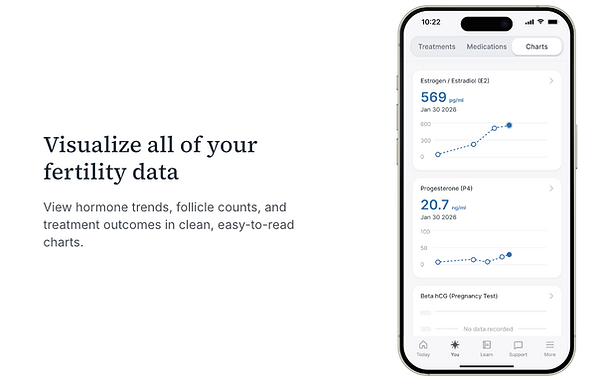
Berry Fertility focuses on supporting women along the IVF, egg freezing, timed intercourse, IUI, and FET journeys. The app's key features focus on tracking and include treatment reminders, cycle tracking, appointment management, and data visualizations of all treatment data.

Competitor Feature Matrix
I developed a competitor feature matrix which includes key features under the categories of treatment navigation, emotional support, clinical and expert support, education and information and tracking and data. I also described how the feature would support women and why it might be important or not.
I ranked each feature on a scale of 1-3, 1=nice to have, 2 =important, 3=critical. My assessment of the importance of features to women was based on the secondary research review.. It was important to not rank each feature the same, since some features may be more helpful than others for women. Additionally, the mere presence of a feature does not necessary mean that competitor would be "better" than another.
A limitation of this approach is that the feature scoring was based solely on the websites of the companies evaluated and features mentioned through marketing language. This process did not include purchasing trials or subscriptions to each tool in order to evaluate feature quality due to cost and access barriers.
The highest possible score a tool would be able to receive based on my ranking was 64. Carousel Fertility came in at 45, Conceive at 42, Tilly at 33 and Berry Fertility at 21.
This matrix helped illuminate that Conceive has a few gaps: mental health/emotional support tools, tracking/data visualizations and egg storage continuity. Currently, Carousel Fertility notes on their website that they cover major areas identified as critical from the research:
-
Financial support - including cost calculators to understand cycle cost
-
Emotional support tools and community matching
-
24/7 clinical Q+A
However, it's critical to note that Conceive details that they have 24/7 support via text, video and calls with nurses. Carousel Fertility's support appears to be mostly asynchronous even if 24/7.


This competitive analysis paints an early picture of what a future tool could include based on an analysis of the gaps across tools:
-
Personalized fertility plans
-
Mental health/emotional support tools such as 24/7 fertility coach access and peer community networks, but also holistic journaling and mood tracking tools, meditations and breathwork exercises, among others.
-
Strong clinical and expert support such as 24/7 access with nurses and fertility expert events
-
Educational information such as peer-reviewed articles, injection videos to facilitate medication management and administration
-
Treatment tracking tools and calendars, including medication reminders and data visualizations to better understand treatment data. This could include cycle tracking.
-
Egg storage continuity such as storage support after egg retrieval cycles are finished and safe disposal tips
-
Community support including peer matching with women based on treatment stage, age and fertility status.
-
Financial support such as sessions with a financial counselor and cost calculators to help determine financing for IVF cycles
Competitor Conclusions and Opportunity
Based on this analysis, Conceive is the only platform currently available on the market today that attempts to provide the most holistic and comprehensive tool for women navigating fertility treatment. Carousel Fertility may fill some important feature gaps but the product is not yet available to consumers.
Existing solutions offer pieces of support across the infertility journey, including treatment navigation, emotional support, expert guidance, education, and cycle tracking/visualizations. Still, these capabilities as a whole are fragmented across different tools and services. There is currently no single solution that integrates these elements into a comprehensive experience that supports both the clinical and emotional complexity of infertility.
These findings highlight an opportunity to design a more integrated support experience, one that helps women navigate both the clinical and emotional complexity of infertility in a cohesive and guided way.
STEP 5: GENERATIVE RESEARCH
PLANNING AND SYNTHESIS
Moderation Guide Development
Next, using the competitive analysis and secondary research insights, I created the moderation guide. The guide is structured around these key research questions, aiming to test existing research hypotheses:
Infertility Journey Challenges + Support
-
How do women experience support before, during and after the experience of IVF?
-
What challenges emerge throughout journey?
Tools and Resources
-
What resources do women rely on for support throughout the journey?
Ideal Tool
-
What support are women missing throughout the journey?
-
What does the ideal infertility support tool contain for women going through infertility and IVF?
The full moderation guide contains 4 main sections: pre-session activity, IVF journey grand tour, support/lack of support and ideal IVF support tool ideation.
Methodologically, the pre-session activity aimed to elicit symbolic meanings of the fertility journey and uncover values early on. It also served as an icebreaker into difficult topics and a general rapport-building technique.
The journey walkthrough allowed participants the freedom to share what they find important about their own fertility journey, focusing on support and lack of support throughout the experience.
Lastly, the ideal tool component empowered users to imagine a fertility support tool that would help them and other women throughout their journey. It serves as a strong input for my future ideation, ensuring that the concept I develop takes into account user needs, pain points and gaps in current tools.
Manual/AI-Assisted Synthesis and Topline Report
For all of my research projects, I develop a Miro board where I keep all de-identified participant notes and map the journey in real-time as I am interviewing. I take detailed notes during interviews, using terminology expressed by participants to mirror and repeat back what I heard for further clarification or elaboration. Each participant gets a designated color sticky note so I can easily see patterns across participants.
This Miro board also enables me to use Miro AI analysis tools as I see fit and undergo affinity analysis during key phases of data collection for topline report development and post-data collection synthesis. This approach, with verbatim notes taken live during data collection, helps speed up manual synthesis tremendously.
An example of a section of the Miro board for P5 is below.

During data collection, I went through the following process:
1) After each interview from P1-P4, I went through my verbatim notes on the Miro board to summarize what I learned and pull out key themes. I added this information for each participant in a Google document. I also used the Miro AI feature to summarize each participant interview. This helped to confirm what I gathered from the interview myself.
2) After 5 interviews, I performed affinity mapping in the Miro board and wrote headers to describe the groups. Then, reviewing the notes and headers, I wrote rough drafts of insights for each cluster.
3) Then, I ran each rough insight statement into Claude to rewrite for clarity. I also gave Claude my Miro board to review and prompted it to find anything that I may have missed that was an insight worth using to inform the final prototype.

4) Since major themes were identified after my 5th interview, I ended up mostly adding supporting evidence from P6 and P7 to existing themes that I identified earlier in data collection. I added sticky notes with supporting evidence directly to the Miro board under previously identified clusters/insights. Any additional important insights were added as separate groups.
STEP 6: FINAL GENERATIVE INSIGHTS AND FEATURE IDEATION
Final Participant Info
Below is a breakdown showing the final participant table of all 7 participants with key details. Four women were currently in any part of the IVF process, one completed the full process from egg retrieval to transfer 2-3 years ago, and two completed it within the last year. This breakdown gave me a strong understanding of the needs and pain points of participants across the entire IVF process from egg retrieval, embryo creation to transfer.

Key Research Insights, Supporting User Quotes and Supportive Feature Ideas
The following insights were generated via the synthesis method detailed above. Insights are broken down by category for organizational purposes and prioritized according to the prioritization elicited by participants during the interviews.
Priority insights and features are noted with a star.

THE JOURNEY: CONTEXT
Insight: Women often arrive at IVF after long, arduous infertility journeys (sometimes 7-10+ years), frequently carrying misconceptions that IVF guarantees a baby and a limited understanding of what the process actually involves.
“It would be helpful to have information from the clinic based off of my diagnosis of unexplained infertility - more information about what the possible options are to pursue. What are the pros and cons of each option tailored to my husband and me?” - P4
"I was naive, thinking you just go through IVF and magically get a baby and its a guarantee. I very much had that idea and held that idea for a couple of years. When I look back on it, it's crazy." - P1
"Before IVF, when I was trying to get pregnant, I was excited. My mom had 7 kids. My sister had 7. I thought it would be a breeze (at 35), that it would not take me long at all." - P7
Feature Idea:
Tailored resources based on your diagnosis - FAQ with explanations on common terms, diagnoses, linked to question bank with questions to ask doctor

Insight: IVF journeys are complex, and failed transfers compound distress, isolation, and hopelessness. Decisions about embryo creation and storage add further anxiety, particularly for women approaching them from a religious background.
“It was hard to find a fertility acupuncturist…the individual is left to figure out what resources are out there.” - P1
"IVF was a big deal for my husband and I, to decide whether or not to do IVF. We're both Christian and I had a lot of feelings about the mortality of these embryos, and in my mind I was like maybe we can wait another month...how do you know when it's the right time to pursue something that is quite invasive and something that has moral implications? I didn't realize the gravity of these decisions I'd have to make until later. I was so emotional and focused on having a family." - P4
"With my first transfer not working, I was devastated. I came home and got drunk, sobbing. At that time, I had three people in my community who were all pregnant...everyone around me was pregnant. You feel like such shit not being thrilled for people...one was a good friend who I had a conversation with. Another was an acquantaince. I avoided her. I'm obviously happy for her, but I'm selfish too...I've had a lot of emarassing moments." - P7
Feature Ideas:
Holistic referrals in your area: mental health resources (support groups, therapists), fertility-focused acupuncturists, naturopaths and therapists who experienced IVF
Embryo storage considerations, ethical and religious resources across denominations
Embryo storage logistical information - questions to ask providers (example: what happens if I move?)
“Early on I sought a mental health therapist, and she knew about IVF. I found out later she had done IVF also. That made an enormous difference for me. Her being specialized was so helpful…she got it because she had lived it herself. It really made a difference for me, she could empathize with me in a way no one else could.” - P6
"I've had to carry a lot of the emotional burden of being infertile. It's devastating." - P7
Feature Idea:
Holistic referrals in your area: mental health resources (support groups, therapists), fertility-focused acupuncturists, naturopaths and therapists who experienced IVF
Insight: Women need emotional support throughout the journey - emotions range from anxiety, anger, and a sense of unfairness to exhaustion, shame, guilt, and frustration. However, the first IVF round or beginning fertility treatment of any kind (such as IUI) in particular may offer renewed hope after a long infertility journey.
Insight: Women who experience infertility often self-identify as type A, accustomed to achieving goals through effort and persistence. Diagnoses like unexplained infertility are especially difficult because they offer no clear answer to search for, leaving that drive unsatisfied.
“I’m naturally a doer, an active person, type A personality. It very much bothers me when I don’t have an answer. I spiral down - what else can I tweak to make this better? I have anxiety around it as well.” - P1
"Seeing other experiences on Facebook made me a little more confident. I tend to hyperfixate and I am pretty type A. It's helpful to see all different experiences. It gave me perspective." - P2
Feature Idea:
Tailored resources based on your diagnosis - FAQ with explanations on common terms, diagnoses, linked to question bank with questions to ask doctor
Insight: Setbacks like failed transfers can prompt women to turn inward - investing more in their own mental and physical health and seeking therapy. This is a way to reclaim some sense of agency in a process that otherwise feels all-consuming and out of their control.
“After news of my second cycle and failed transfer, I’ve felt emotionally stronger and stronger. I’ve been working on taking care of myself and encouraging myself to do more for myself. I started seeing a therapist and an executive coach.” - P5
Feature Ideas:
Mental health resources or therapists in platform
Find a provider tools
Recommendations for what next after failed transfers, how to take care of yourself despite setbacks
Guidance and options on what happens when a path stops working and a woman has to decide what's next - donor eggs, surrogacy, stopping treatment, or trying naturally. Information on questions to ask providers and tests suggested to take if reaching this stage.
Insight: Treatment is exhausting. Taking breaks is critical for supporting mental health. This could mean taking breaks in-between cycles of IVF, breaks from work through Paid Family Medical Leave (PFML) or breaks from content consumption.
"Time off from work was life changing, with PFMLA during treatment. Just working as a nurse - it's so physically demanding. I remember this sense of hyper vigilance about my body...if I had a rough shift, lifted a patient, strained my body, I would say, I shouldn't have done xyz. There was always a sense of needing to find something to blame. Having some time away from work during treatment helped protect that a little bit." - P6
"We took a month off in-between transfers to recover after my failed frozen transfer that didn't work...we wanted a break." - P7
Feature Ideas:
Time limits in-app
Recommendations on how to spend your time when on a break from IVF, tips on how to obtain and secure PFML from work for treatment
“A time limit would be helpful. Sort of like Netflix - are you still watching after 4 hours? You’ve been on this for an hour, do you want to continue? Like scrolling on Instagram…you don’t even realize you’ve been on it for 30 minutes. With fertility stuff, it’s very easy to read one article, which leads you to something else, and then you’re spiraling when you do it.” - P1
Insight: Women may remove past failed cycle data or cycle tracking apps from view altogether, since they can serve as painful reminders of loss or difficulty during the journey.
Feature Ideas:
Ability to hide past failed cycle data (medication logs, calendars, and treatment history) but still access if desired for history and reference on future cycle planning
"Taking a break" features explicitly called out in-platform to allow for silencing support during recharge times
“I have a binder where I keep my cycle information. I take out prior cycles but I keep the information…I like to keep it for my own expectation setting. How did this go last time? I have a record so I can refer to it later if I need to.” - P5
“I deleted my period tracking app…it doesn’t bring back good memories.” - P4
TREATMENT OPTIONS
Insight: Women may seek holistic support alongside treatment - acupuncture, yoga, supplements - and prefer when these recommendations come from their provider rather than discovering them independently.
“In the beginning, there were no discussions from my provider about what are all of the things I could do, like acupuncture, etc. Doctors are very focused on the science and putting egg and sperm together. I felt very unsupported then. Now she’s recommending fertility acupuncture, books, and yoga - she might have learned about them now too.” - P1
"I found out about a fertility-specialist acupuncturist via Google...I think I found out about doing acupuncture via Reddit. Anything actionable I can do...I need tasks I can do. I need to feel like I'm contributing to this because it feels like you are just letting your body exist and hope it works out. I need to feel like I am making this happen...it offered relaxation if nothing else...my clinic actually also had contracted acupuncturists in the same building for appointments a few hours before or after retrievals and transfers...so great." - P7
Feature Ideas:
Mental health resources or therapists in platform
Find a provider tools
Fertility yoga and supplement recommendations endorsed by providers with medical-endorsement marker
RELATIONSHIPS AND WORK
Insight: IVF affects relationships across work, friends, and family - women may struggle navigating friendships when pregnancy outcomes diverge in either direction. They also may find family members do not always know how to respond when treatment is disclosed, and they aren't very supportive overall.
“I didn’t share much with my close friends about my fertility journey…all of the questions they asked me with good intentions made me feel like something was wrong with me. Like I was failing everyone.” - P3
“I was not talking about IVF with my friends who had not done it, they don’t get it.” - P6
“Two people in particular, we were close friends with but they won’t engage with us anymore at all. It’s because we have children, and they weren’t able to. They had to stop their journey. It makes it really sad and hard to still be connected to people who are still trying…it’s sort of like survivors guilt.” - P6
“It’s hard when someone else’s deepest joy reminds you of your deepest pain. There were times when I wanted to be a great friend to friends who were pregnant, but if they haven’t experienced infertility it’s hard. There were times when I felt like I also failed showing up for friends because I was jealous.” - P4
"My coworker was 8 months pregnant and she offered me her pregnancy clothes. I'm not pregnant. I don't know what I'm going to do with these. I felt like a shitty person because then I'm mad at this person who is trying to be nice to me." - P7
Feature Ideas:
Scripts and templates to help navigate conversations with boss, HR, friends, family
Insight: Partners are a significant source of support, both through their steady presence and through specific roles they may take on, like note-taking during appointments or handling injections.
"I would love a world where my husband has access to the same info as I do, so I'm not playing middleman... you have a lot to coordinate when you're going through IVF. I had to talk to a financial services rep. I would love if she could have worked with husband, handling meds for treatment...to be able to outsource one part would be great, but because I'm the patient, everything comes to me first - the system doesn't allow it ." - P5
"My husband came to all of my fertility appointments with me." - P7
Feature Ideas:
Shared partner access and login tools
Recommendations for how to involve your partner in each part of the IVF process across treatment timeline
Ability to take notes for each clinic call in-app and receive AI-generated suggestions for questions to ask during the next visit or via clinic portal
“One thing my husband started doing was creating a Google doc, with a list of running questions we wanted to ask the doctor, so he would take notes during our meeting which was helpful.” - P4
“My husband ended up doing his own support group. This in turn helped him support me…he was able to talk about what other people were experiencing too. He could get the feelings of helplessness on his end off his chest without bothering me about it.” - P6
“My partner would help me with injections…I couldn’t do them.” - P3
Insight: Work is a meaningful source of support for many women, through employer-sponsored IVF coverage, educational benefits like Maven, access to therapists, and understanding managers.
Feature Ideas:
Scripts and templates to help navigate conversations with boss, HR
“This journey is so isolating even though I know a lot of people go through it. My biggest support is my work. We have an infertility support group. It’s been so helpful for even mundane things - how does this work? What worked for you and what didn’t? “ - P1
“I found an email template to send to HR and your boss to tell them about treatment in this book that was really helpful throughout my journey…it had practical resources.” - P5
FINANCING IVF
“I spent two years applying to grants to afford a round of IVF, we googled grants on our own. We spent a lot of time trying to understand how people do this. How do you get a large sum of money up-front? We found them via Facebook and searching ‘ten best fertility grants.’ Some were lottery based - you buy a ticket and then there’s a random drawing from the ticket pool for a winner.” - P2
"Lupron is especially expensive. It ended up being covered by insurance. I was grateful as it would have been $6,000 for two rounds of the meds...there are manufacturer coupons that you can use. I posted something on Reddit to see if anyone knew how to get them for cheap. But the manufacturer will give you a discount for a 3 month supply only, I only needed a two month supply...I had to navigate how to get these meds at a more affordable price." - P6
Feature Ideas:
Financial resources: tips on how to access IVF funding and lists of grants to apply to
Insight: IVF's cost is a significant hurdle, and women are largely on their own to find grants and funding unless their own or a partner's employer offers financial support for treatment.
Insight: Women may have to navigate insurance themselves, calling back and forth to figure out coverage. This is a significant burden.
“I had to call insurance about approvals constantly, it felt necessary so I wouldn’t get lost in the system.” - P4
“Lupron is expensive. I fought with them so hard to get insurance to cover it.” - P6
Feature Ideas:
Tips on how to navigate insurance yourself or concierge services to navigate insurance for you
Templates, a place to log who said what, prompts for what to ask insurance and HR about treatment benefits
PROVIDERS: A COMPLEX SOURCE OF SUPPORT
Insight : Providers are perceived as supportive when they're responsive, are proactive with information and explanations, set realistic expectations about outcomes, and take a holistic approach - offering resources like yoga, acupuncture, support groups, and mental health support.
“My fertility doctor was my main source of contact. I liked her. She was not the warmest, fuzziest person if I’m honest, but she was great with information, setting expectations. I really appreciated her for that.” - P2
“I had a nurse who was really helpful. She was extra communicative about next steps - always calling, emailing, texting. She was very proactive in helping me know what was coming. I haven’t experienced that level of attentiveness with healthcare providers normally.” - P4
"I had a really responsive clinic, with text availability. They were quick to respond to messages. I don't necessarily need a quick response, but the accessibility...I didn't have to get into my computer, log onto the portal. I had a contact in my phone that was my nurse - text was convenient." - P7
Feature Ideas:
24/7 support from nurses - chat
“I had a great doctor at the clinic, but if I’m not actively going through treatment, I don’t get to talk to them or see them.” - P1
“I was prescribed letrozole and my doctor said take it every day for a month but they didn’t tell me the purpose of it. I had to look that up myself.” - P4
Feature Ideas:
Recommended questions to ask provider based on your situation for each stage of process - such as a Question Bank
Insight: However, providers are often rushed and not proactive with offering information and education on calls. Clinical support also disappears for women outside active treatment cycles.
Insight: Providers tend to remain clinical, offering sterile, medically-focused resources without emotional support. As a result, women build their own workarounds (YouTube, Instagram, books, and similar sources).
Women look for "day in the life" content from patients and medical content from providers that is more relatable and concrete with visuals (example: doctors on YouTube showing equipment used during procedures).
This content is empowering: it restores a sense of control, sets expectations, eases anxiety, and reduces isolation during a challenging process.
“Our doctor gave us a huge pamphlet of what to expect during IVF, it felt a little clinical, focusing on the hard facts of it. I read through that but I didn’t feel like it gave me as much support and peace of mind as much as the other stuff did - the more personal stuff I found on my own like on YouTube, with people sharing their stories is a lot more helpful.” - P2
“I watched several YouTube videos to learn about my cycle and just general knowledge about infertility. I liked learning about the women's body, and this was something I was not getting through fertility clinics.” - P4
"I would listen to podcasts or watch YouTube videos...like from Dr. Lora Shahine. It was comforting to know I'm doing what I need to do and there's no magic bullet (to getting pregnant). I would watch or listen to stuff to help me understand how my body works or is supposed to work, and subconsciously I realized I was doing everything I was supposed to do. If it doesn't work, it's not me. Did this baby stick because I drank this stupid beet juice watermelon thing? I don't know....but relationally mattered to me more - talking to other people (friends, Reddit) who had been through it. This was usually just doctors going through the process." - P7
Feature Ideas:
“Day in the life” videos available in platform based on specific situation - diagnosis, age, stage in treatment, etc. to enhance relatability (Example: day in the life of someone age 40 with low AMH undergoing egg retrieval round #2)
Medical-focused provider videos to show process, equipment and understand more about fertility/female body
Insight: When providers don't respond quickly enough during time-critical moments such as medication administration, women turn to Google or ChatGPT. They value AI's constant availability and patience, but this can lead to research spirals that increase anxiety and leave women still not fully trusting what these tools tell them.
“I would Google things after a lot like why would I be prescribed Letrozole? I trusted anything on the internet - that felt more comfortable quicker to get that knowledge vs. sending a message through the portal.” - P4
“I used ChatGPT to calm down - I was so anxious during pregnancy, it tries to calm me down, provides me with data that can prove that I am fine, I am naturally an anxious person. My therapist isn’t available 24/7 but ChatGPT can always help to ground me and calm down.” - P3
“I Googled more about the polyps they found during the HSG since they didn’t explain much to me and the internet told me it could be a six month recovery…I was down this path and my husband caught me doing this and said we should call the doctor and just talk to them.” - P5
Feature Ideas:
24/7 support from nurses - chat
Time limits to prevent endless scrolling, gentle reminders to ask if user still desires being on the app reviewing content
“I had so many appointments to measure follicles, if not big enough at certain times then I can’t do egg retrieval I asked them if they could write down size of follicles for me. I was curious would like to know how body is doing vs just hearing ‘come in again tomorrow.’ “- P4
Insight: Providers often explain just enough to get by, leaving women to fill real gaps on their own - from understanding what a diagnosis or follicle count means, knowing what to ask, finding mental health or financial support to figuring out medication storage strategies.
Having enough explanation and education from providers is critical as women feel disempowered without it. They feel the burden to figure it all out on their own and advocate for themselves and their care without this support.
"When I first got my low AMH diagnosis, I felt unsupported by my doctor. I didn't truly know what that meant and I didn't know the right questions to ask." - P1
Feature Ideas:
Recommended questions in Question Bank to ask provider based on your situation for each stage of process
Tailored resources based on your diagnosis - FAQ with explanations on common terms, diagnoses, linked to question bank with questions to ask doctor
Cost and legal checklist that prompts user to ask the right questions to their provider (common considerations for embryo storage fees, embryo ownership and storage details - what happens if a partner dies, how many embryos to create ideally based on desired number of children, consent terms, embryo disposition) + place to log the answers once they have them
“I made a calendar for us in Canva, I took the doctor’s calendar and put it on my fridge…made it prettier. I also ended up creating a bar graph with how much medication I had, with every shot I gave myself I would highlight and date it, so I knew I didn’t miss anything. It was nice to see visually how much I had left.” - P2
Insight: Some women take on extra manual work in notebooks or bar charts to track ovulation test results, pregnancy test results and medication management. They do this to keep track of important data points, consolidate scattered information, discover patterns in data and better understand what is happening in their bodies. It provides a sense of control.
"I had a notebook with different layouts - month, weekly, for a combination of tracking for medications, calendars, notes for calls back and forth with my doctor, a diary/journal...I appreciated having a physical notebook and using Google calendars. I had one place to scribble everything - that was appreciated. I had so many calls back and forth, questions. I could also take out pages from prior cycles and start new ones." - P5
Feature Ideas:
Ability to upload treatment plan and calendars from clinic to receive visualization of personalized treatment timeline with key decision points (example: embryo storage, what happens if a partner dies, how many embryos to create) on calendar and ability to integrate with your own personal Google calendar if desired
Medication support feature in-app for tracking/inventory with reminders, examples of storage, injection videos with diverse bodies as examples
Ability to take notes for each clinic call in-app and receive AI-generated suggestions for questions to ask during the next visit or via clinic portal
“I wish I was told I would have to make so many decisions with IVF. I had to make these decisions one by one…it would have been helpful to have a resource that gave us an overview of the process and how long it takes, a breakdown of each step and decisions that need to be made at each step. I'm picturing a timeline with decisions needing to be made underneath it. It would help set expectations by knowing every stage, another thing that needs to happen? I felt like, why didn't you tell me about this before? It always felt like a curveball.” - P4
Insight: Women are inundated with decisions throughout a process they don't fully understand, and want information up front (before agreeing to egg retrieval) about what to expect and the implications of each decision. This helps them make informed choices about their treatment and know what's coming.
Feature Ideas:
Ability to upload treatment plan and calendars from clinic to receive visualization of personalized treatment timeline with key decision points on calendar and ability to integrate with your own personal Google calendar if desired
FERTILITY SUPPORT TOOLS
Insight: Women want personalized recommendations from fertility tools based on their specific diagnosis and situation.
“Fertility apps feel generic. The onus is on us to figure out how to piece it out and what applies to me. These apps just make you spiral more.” - P1
“I used fertility tracking apps most often because I was tracking my ovulation cycle. This would also give personalized recommendations on when we should try to conceive.” - P4
“The book I read throughout my journey would have been more helpful if there was any way to personalize it. Here’s her story, but thread my experience through it. Like a digital offering where you could give it basic details of where you are and it could structure content accordingly. If you’re about to start your first round, here’s details about how to deal with needles. Based on what stage you’re at, here’s what to expect based on where you are.” - P5
Feature Ideas:
Tailored resources based on your diagnosis
COMMUNITY SUPPORT
Insight: Some women are very private about their IVF journey and don't disclose it, even to friends or family. However, once they do open up, they often discover infertility is more common in their existing community than they previously realized.
“We’ve been very private about our experience…I think it’s a preservation thing. It’s me and my husband - us against the world.” - P5
“I don’t come from a family where we talk about our feelings much, and socially I’ve started to find people who have gone through similar or same experiences. Now 5 years into my journey, but for the first 3.5 years, it socially felt very isolating - this stands out the most to me…I have a community now. Over the last 5 years I’ve started to be more open about it. The more open I was about it, the more people were like, ‘oh, we did IUI,’ and I was like, ‘I never would have known.’ ” - P2
Feature Ideas:
Scripts and templates to help navigate conversations with friends, family
Insight: Generic support group content, large open digital community boards, and random matching don't always meet their need for community. These forums can fuel comparison and anxiety through unfiltered viewing worst-case-scenario stories rather than supplying genuine connection. However, they can be a helpful source of information, too.
In order to find more connection, women want to be matched by diagnosis, location, age, stage of treatment, desired frequency of contact, and desired mode of contact. Some prefer "view only" access to read others' experiences and others wanting more active, in-person connection.
“Online groups feel more conducive to comparison vs. connection and support....closed, smaller groups would be better - where you have some interaction that is not just typing, more face-to-face interaction.” - P5
“Facebook groups gave me more anxiety. Usually you can see horror stories here, people don't usually post about their success - especially in these groups. It makes you feel that the probability of failure is very high, or miscarriage is very high. But they are a good source of information…they are not good in terms of support if everything is fine because they just give you more anxiety.” - P3
“It would be helpful to be linked to others in your situation - here’s where I am in my journey - like middle of IVF, number of rounds, etc.” - P1
“For more support and connection, it could be interesting to have a group of people who are starting cycles at the same time…maybe matched by age, stage of treatment, diagnosis, nearby or not? Would I prefer a more distributed group? Because being more anonymous sometimes is helpful when engaging on challenging topics. Availability, time of day to connect.” - P5
“I joined the Facebook group Hope and Support in _____, seeing other people explain how their retrieval went. I don’t post often but seeing people chime in, and share their experiences and seeing a variety of experiences, it made me a little more confident. It was helpful to see all different experiences, it gave me perspective.” - P2
"On Reddit, I would go in and check out whatever question I had...and I would read what people had to say about whatever question I had at that time...it was nice to read IVF success stories, even with my second FET, I would see how many people had a successful round. Even though it doesn't change anything or make a difference, it was nice to feel hopeful, like maybe that could be me." - P7
Feature Ideas:
Matched community support based on age, diagnosis, location, treatment stage, desired frequency of contact, desired mode of contact + “view only” options without in-person contact
Key Takeaway
Across seven interviews, one tension surfaced repeatedly: women undergoing IVF are navigating one of the most emotionally and medically complex experiences of their lives, but the support available to them is scattered across disconnected tools, communities, and providers that were not designed to work together.
Clinics provide just enough clinical information to get by, then go silent between appointments.
Online communities offer connection but can fuel anxiety.
Generic apps offer tracking without context and personalization.
No single resource holds the full picture.
Cairn is designed for what lives in the gaps between all of these — the moments after a monitoring appointment when no one has explained what the follicle count actually means, the night before a transfer when the question to a nurse feels too urgent to wait for a portal response, and the day after a failed transfer when every existing tool defaults to engagement rather than grief. The features that follow are built around those moments.
Data Sanitization Measures: Post-Data Collection
To ensure participant privacy in a sensitive healthcare space, after data collection and insight development, I deleted all recordings with participants. I also deleted names from the participant management spreadsheet.
STEP 7: AI-ASSISTED INITIAL CONCEPT DEVELOPMENT
(LOGO, MISSION, FEATURES)
Introducing Cairn Fertility - Iteration #1
Based on the user research insights, I used ChatGPT to help develop a logo and mission statement and overall concept for my product design project. I landed on "Cairn Fertility."
I decided on a soft color palette focused on shades of purple and pink. Purple signifies loyalty and trust, it's also a traditionally feminine color. A dusty pink is also calming and associated with femininity. I used ChatGPT to help refine the color palette based on this color theory. The overall color palette below aims to point to trust, femininity, sophistication, calm and emotional safety.


Color Usage Guidelines
Deep plum will be used for the following throughout the prototype: logo text, headlines, navigation and body text
Royal violet will be used for section headings, supporting copy and icons
Bright coral will be used sparingly for buttons, CTAs, progress states and highlights
Dusty rose and warm lavender will be used for charts, tags and community features
Petal will be used for the background of the platform instead of pure white, to help enhance the deep plum to feel softer and richer.
Cairn's Mission Statement
Fertility care doesn't happen only during appointments. From first questions to retrievals, losses, pregnancy, and long-term decisions, Cairn provides personalized education, emotional support, expert guidance, and community - helping people navigate every stage of the journey. Because people don't necessarily need another doctor. They need someone with them between those moments.
Why the Name Cairn?
A cairn is a stack of stones left by travelers to help others find their way. They are markers on difficult terrain - a sign that someone else has been here before, kept going, and left something behind to guide those who come next. Like the fertility journey itself, they hold space for hope, grief, uncertainty, and change. A comforting reminder that you're not lost. And you don't have to carry this alone.
Cairn's Target User
Cairn is for women currently undergoing IVF who already have a clinic and a fertility provider in place. It's built for what happens outside the appointment - the medication math, the decision nobody warned them they'd have to make, the 1am research spiral. It assumes clinical care is already being handled elsewhere, so it isn't trying to be another doctor; it exists to cover what clinics struggle at: personalized education, decision support, financial transparency, and community matched by actual situation rather than just "also doing IVF." Cairn is for someone still feels like no one's with them for the rest of it.
Target user: Women currently undergoing any phase of the IVF treatment who have an established clinic and fertility provider in place. Edge case is women who are in-between cycles, taking a break from treatment, and do not have active support from their clinic.
Assumption: Clinical care (diagnosis, protocol, procedures) is handled by the existing provider and is out of scope for Cairn. Cairn is not integrated with clinic systems, but users can upload data from clinics for more support. It is a standalone support tool.
In-scope: Support between appointments - treatment and decision education, financial/legal cost disclosure, and peer community matched by diagnosis, treatment stage, and situation rather than general affinity.
Out-of-scope: Users who have not started treatment, are deciding whether to pursue IVF, or are searching for a first Reproductive Endocrinologist.
Cairn's Full Feature Set - Prioritized
Final priority for MVP features to build for the AI prototype listed below was determined based on a review of the competitive analysis gaps, user research and Cairn's intended audience/positioning.
Note that this is the final full feature list of Cairn - priority refers to build, not to what exists within the product.
.png)

Clinical Regulatory Reality of Cairn Features
Cairn is relatively low risk. Content and education features such as curated articles, Day in the Life videos, FAQ content, resource libraries are largely out-of-scope for FDA regulation since they’re a standalone consumer product positioned as general wellness information rather than clinical guidance. Community features, matching, and partner access tools are similarly low-risk from a regulatory standpoint. These are closer to a support forum than a medical device.
Higher Risk Features - 24/7 Nurse Chat and Question Bank
The 24/7 nurse chat feature is the highest-risk element in Cairn's feature set. If nurses are giving individualized clinical guidance through the platform, even informally, this creates liability exposure and potentially triggers FDA oversight depending on how the feature is scoped. The distinction that matters is between a nurse saying "here is general information about Menopur mixing" versus "based on your specific protocol, you should do X tonight." The second is clinical advice and carries real liability. Any nurse chat feature would still likely require clinical partnerships, liability insurance, clear scope-of-practice boundaries, and terms of service that are explicit about what the feature is and is not.
The question bank feature is worth flagging too. Generating personalized questions based on a user's diagnosis, stage, and outcomes is valuable, but if the questions are wrong or miss something important, there is a question of accountability. Framing matters here: "questions other women in your situation have found useful to ask" is lower risk than "questions you should ask your doctor."
The FDA Landscape for Cairn
The FDA has a framework called Digital Health and Software as a Medical Device (SaMD). Whether Cairn would fall under it depends on whether any feature is intended to diagnose, treat, cure, or prevent a disease or condition. Content and community features generally do not. A feature that analyzes a user's inputs and generates clinical recommendations potentially does. The FDA has enforcement discretion for lower-risk wellness tools, but that discretion is not a guarantee, and the landscape has been tightening.
HIPAA and Cairn
If Cairn ever ends up integrating with clinic systems or receives data from an EHR, HIPAA applies. This is not the plan for Cairn currently. It is a standalone consumer app where users voluntarily input their own health information - HIPAA technically does not apply in the same way. However, users will assume it does, and the trust expectation is effectively the same.
A clear, plain-language privacy policy about what health data is collected, stored, shared, and deleted is non-negotiable from a trust standpoint even if it is not strictly legally required at the consumer app level.
Feature Plan for Proof of Concept MVP Prototype
The features to build for the prototype will focus on the following high-priority items to demonstrate Cairn's capacity. Not all high-priority features will be included in the Proof of Concept MVP prototype due to limited scope, budget and time for the project.
-
Login experience with privacy policy
-
Time limits to prevent endless scrolling, gentle reminders to ask if user still desires being on the app reviewing content
-
Visualization of personalized treatment timeline with key decision points on calendar and ability to integrate with your own personal Google Calendar if desired
-
Failed transfer state
-
-
Question Bank personalized to you with questions to ask your provider based on your stage of treatment, current outcomes and diagnosis
-
Partner access tools
-
Matched community support based on age, diagnosis, location, treatment stage, desired frequency of contact, desired mode of contact and "view only" options without in-person contact
-
24/7 chat support with nurses
-
Tailored resources based on your diagnosis
-
FAQ with explanations on common terms/diagnoses
-
"Day in the Life" videos available in platform based on specific situations - diagnosis, age, stage in treatment, etc. to enhance relatability
-
Provider videos to show the process and explain the process further
-
STEP 8: AI-ASSISTED JOURNEY MAP
Journey Map Development with Claude
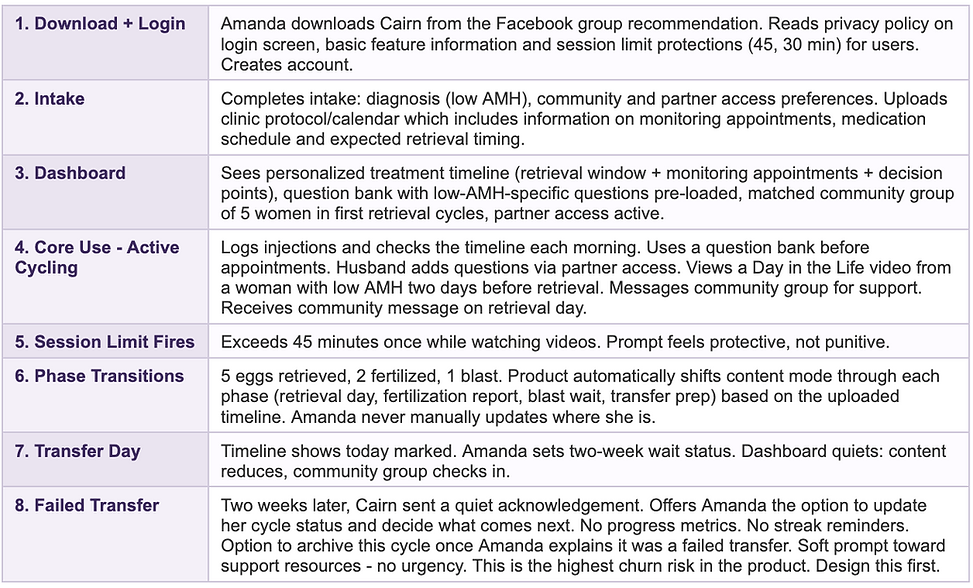
Next, using the insights from the user research, top features to build for the MVP, and my portfolio site, I instructed Claude to develop a journey map for a fictional user named Amanda. I will use Amanda's scenario and this journey map to develop the prototype screens with Figma Make.
Amanda's Scenario
Amanda is in her mid-30s and beginning her first IVF cycle after being diagnosed with low AMH. She is receiving care from an reproductive endocrinologist and has just received her stimulation protocol from her clinic. Although her partner wants to help and share the coordination load, Amanda finds herself managing the information burden as she's the patient. Feeling overwhelmed by medication schedules, appointments, and questions she wants to ask her care team, she starts creating spreadsheets and notes to stay organized.
Searching for additional support beyond her clinic visits, Amanda discovers Cairn via her Facebook infertility support group and joins at the start of stimulation. During onboarding, she uploads her clinic calendar and completes an intake that personalizes her experience with low-AMH-specific resources, a question bank for upcoming monitoring appointments, and a matched community group of women going through similar first cycles.
Over the following weeks, Amanda relies on Cairn to navigate stimulation, retrieval, the blast result wait, transfer preparation, transfer day, the two-week wait and her transfer outcome which devastatingly is not successful.
Throughout the process, Cairn helps her stay organized, prepare for appointments, and find emotional support during the moments between appointments, when uncertainty is highest and existing tools and clinic support often fall short.

A Note on the Failed Transfer State Decision
The decision to prototype Amanda's failed transfer state is highly intentional as a design challenge - this is the highest churn risk in the product and a difficult one to get right. If Cairn sends a routine engagement notification or responds without empathy the day after a negative result, the relationship is permanently broken. My research data supports this - women described the emotional weight of failed transfers as some of the most isolating and unsupported moments of their entire journey, with no clinical touchpoint and no product that acknowledged what had just happened.
Designing carefully for this state is also likely a meaningful differentiator, because no competitor in the analysis has mentioned a product response to treatment failure.
Getting this critical moment right is what earns the long-term relationship with Amanda, and with every woman who goes on to need a second cycle. Designing for moments of grief and failure is one of the most difficult problems in product design, and Cairn's response to a failed transfer demonstrates that a product built for this population must be capable of holding the hardest moments of the journey, not just the hopeful ones.
STEP 9: DESIGN BRIEF
Next, using the assistance of Claude, I developed a design brief outlining the following information: opportunities, target user and scenario, MVP features to build to demonstrate Cairn's capacity and user experience, constraints, brand color palette, and priority screen requirements. This design brief acts as a comprehensive input for my AI prototyping prompt within Figma Make.
The brief also includes real de-identified calendars from a fertility clinic from both egg retrieval and transfer protocols, these are inputs into the AI prototyping tool to ensure that Amanda's timeline feature will be accurate to an actual cycle for someone diagnosed with low AMH.
A key table from the brief and the calendars are below.


STEP 10: PROOF OF CONCEPT MVP PROTOTYPE - FIGMA MAKE
ITERATION 1
Once the design brief went through multiple iterations via Claude prompts and my own edits to finalize, I used it as an input for Figma Make to create an initial prototype of Cairn in a day. The inputs for the initial prompt included the following: Cairn logo, Design Brief, Retrieval and Transfer Calendars and Cairn Brand Colors.
In the prompt, I also included information about brand tone and language, as well as accessibility and device constraints.
This MVP contains only the highest priority features identified from the research (see table above), any future features would be incorporated into subsequent iterations. These includes features such as financial support and medication management support.
Demo Buttons for Stage-Switching
This proof of concept MVP prototype contains multiple stage-based demos. The prototype includes the ability to navigate between stages of the process with a grey navigation button (see below) at the top right corner of the screen - this is for demo purposes only and would not be shown to the user. The demos present are as follows:
-
Stimulation phase and prior to egg retrieval
-
Transfer day
-
Two-week wait for Beta pregnancy test
-
Failed transfer state


.png)
Select Feature and Experience Screens: Time-Limit/Anxiety Guard, Onboarding Intake, Partner Collaboration
.png)
.png)
.png)
.png)
STEP 11: FIGMA PROTOTYPE + LOGO/COLOR PALETTE UPDATES, ITERATION 2
Updates to Copy, Logo, Font Sizes and Color Palette
Upon creating the Figma Make prototype, I decided that the color choices and contrast were not sufficient. I used the WAVE Web Accessibility Tool plugin on a few screens of the Figma Make prototype and realized I needed to make some quick changes.

Without time to do a proper full accessibility review, I opted to use ChatGPT to assist with finding a replacement for the background of the prototype and bright coral color which would help with some of the major contrast issues in the Figma Make prototype and meet WCAG 2.2 AA standards.
I also wanted to increase some font sizes that Figma Make had created in the MVP prototype to better meet accessibility requirements. Despite prompting Figma Make to meet accessibility standards in the Design Brief, there were still issues with font sizes and colors.
I also decided to edit copy. It was important to me to use select participant language from the interviews for the copy, especially for the failed transfer state. For example, women often described a failed transfer as "devastating," signaling the absolute emotional and mental havoc a failed transfer can cause for women undergoing treatment.
I went through the Figma Make prototype and converted screens to Figma. Then, I changed the bright coral color to teal throughout the prototype, updated the background color for higher contrast and updated copy where it was necessary.
Hot spots help assist navigation of the Figma prototype.
This prototype is considered the most final version, iteration #2. The updated logo and color palette are below.


Select Updated Feature and Experience Screens: Stimulation Homepage, Question Bank, Beta Test and Failed Transfer State


.png)
IDEAL NEXT STEPS &
LIMITATIONS
Ideal Next Steps - Research
-
FOLLOW-UP DISCOVERY RESEARCH: Out-of-scope for this particular project, but a valuable addition would be future discovery research on challenges women who conceive via IVF experience post-positive pregnancy test. Research shows that women who have a history of infertility may have a higher risk of perinatal mood disorders vs. those who do not. This indicates a possible need for Cairn support post-IVF.
-
EVALUATIVE RESEARCH WITH THE CAIRN PROTOTYPE: Given my own pregnancy timing and a lack of incentives for participants in this project, a round of evaluative research with the Cairn prototype was not possible but would be an ideal next step. This research would include moderated usability testing with the Cairn app prototype with 5-7 users. Overall understandability, satisfaction and usability would be assessed with this research. Edits to iteration #2 would be based on insights from the evaluative research, creating an iteration #3.
Limitations
-
ACCESSIBILITY: Ideally, accessibility should have been fully assessed, especially for color contrast, prior to development of the initial logo and color palette. I used the WAVE Evaluation plugin on a few pages of the Figma Make prototype, and it was clear that there were low contrast issues with the coral text and petal background. Given this prototype is an MVP for a hypothetical tool and time is limited for the project, a full in-depth accessibility review with the Figma prototype would be prioritized in a future iteration #3.
-
SOLO TEAM: Additionally, given this was a personal project - it was mostly an exercise in displaying my full research and design process to future employers and practicing utilizing AI tools. There was no collaborating product team; instead I acted as UX Researcher, UX Writer, UX Designer and Product Manager. In a situation where Cairn was being developed by a team, additional steps like collaborative feature ideation in a workshop format and feature prioritization against business objectives and effort/impact would have taken place. This would have taken each research insight further and ensured maximum impact.
IMPACT
Impact to Participants - Catharsis and Validation
Numerous participants explained they enjoyed the therapeutic process of the interview and sharing their story, many becoming visibly emotional on the call when asked to reflect on their experiences. I also received an email from one participant after the project concluded, this note proves the power of the project for participants.
"I popped in to your website this morning and just wanted to say you’ve done a very nice job with Cairn. The insights resonate and the design is well considered. Thoughtful work like yours is how we’ll get to a better future for anyone in fertility care. Thanks for the opportunity to take part!" - P5
Impact to Researcher - Enhancing Trauma-Informed Practice
This project was an exercise in enhancing my own research practice across all stages of the research and design process. I am more confident now in my ability to run a study solo for a true client from start to finish, especially on sensitive topics related to healthcare. My trauma-informed research practice is stronger because of this project. Before the project began, I read the book "Inviting Depth" by Brandon Berry and Tom Williams. This book laid out techniques for building trust with participants. Some key developments in my practice reflect what I learned in this book and include the following:
-
Create a pared-down discussion guide to let conversations move more freely: At first I had a longer discussion guide with multiple questions and sub-questions but after my pilot/interview #1, I reduced it significantly. For the reminder of my interviews 2-7, I had only 4 main questions for the interview guide, and the rest were impromptu follow-ups specific to what the participant was telling me. This helped me focus on my key goals and what each participant was telling me, without extra distractions.
-
Help participants share their emotions: The book "Inviting Depth" by Brandon Berry and Tom Williams taught me a technique for building trust with participants: "Occasionally, you can deepen emotional intimacy by sharing a brief personal anecdote that might resonate with the participant's experience. When offered with care and restraint, a disclosure like this can help them feel more comfortable expressing their own emotions." I would normally never do this in an interview. I make an explicit call-out in my intro that the focus is always on the participant and what I could tell them is not important in the context of the interview. However, this situation was unique. All of these women knew I also went through IVF, I told them in the beginning. It made sense at various moments throughout some interviews to share a small word of validation - that I understood what they meant from my own experience too. Sometimes they actually asked me - "you know what I mean?" and I knew it was a tradeoff of trust-building to say deeply and empathetically, "yes, I do, and ____."
-
Prep participants to open up with a pre-session activity: I asked my participants a few days before via email to come to the interview with an object that represented their fertility journey. This served as both an icebreaker and rapport building technique, but it also gave me a window very early on into their struggles, mental models and values.
I saw objects like a ring/"push present" that reminded the participant of a pregnant woman's body, a fluffy emotional support dog, a wine box for holding medications that was a clever object to conceal the journey from friends and family, a tool to support syringe usage for a woman with a fear of needles, a little imperfect rose quartz heart stone, a purchased baby boy onesie that was an act of faith before pregnancy, among others.
Impact to Researcher - Getting Noticed
I decided to share my case study directly with other founders in the women's healthcare and fertility space. This is an ongoing process but the impact of the project is clear. I look forward to continuing to share the Cairn case study with future potential employers, and taking the project further.
"What you’re building sounds genuinely thoughtful, and the gap you’re naming is real. I have no doubt the research you’re doing will land somewhere meaningful...Wishing you real luck with the case study and everything that comes after it."
- Sarah Lewen, Founder of Carousel Fertility