

INFERTILITY SUPPORT PLATFORM PRODUCT DESIGN
Secondary Research, Generative Research, Participatory Design, Wireframing, Proof of Concept AI Prototype and Figma Prototype
(WIP, 2026)
Project Overview
This independent, self-directed UX research and design project explores how women who have experienced infertility, particularly those who underwent IVF, navigate support across their journey. The study focuses on what tools and resources women used throughout their journey for emotional, practical, medical and mental health support.
Drawing from both my professional background in healthcare research and my personal experience, I set out to better understand the lived experience of infertility.
The ultimate goal of this project is to design a vision for a better support platform that serves women experiencing the isolating journey of infertility.
I am working on this project while I engage in product design coursework during the summer of 2026 with Design Lab.
Methodology
This project involves a mixed methods approach, including the following:
-
Secondary research using peer-reviewed articles on topics related to infertility, support that women need and key pain points/challenges women face. This research review will help me to identify known themes and begin to frame the problems facing women.
-
Competitive analysis including a feature comparison matrix of three main competitors: Conceive, Tilly and Berry Fertility. This analysis will determine gaps in current products and where they fail to meet the needs of women. It will also help me understand key opportunity areas for my future product. Overall, I will analyze how well these current products support the fertility journey.
-
Generative research: ~8, 60-minute in-depth interviews with women who experienced trouble conceiving in the last 3 years and underwent IVF. This primary research will help me deeply understand the lived experience of women undergoing IVF and struggling with infertility, informing key problems to solve with a future solution These remote interviews are participatory in nature and will involve the following key components:
-
Live journey mapping in Miro to understand the fertility journey - key milestones, pain points, decision points, resources and tools utilized, and overall outcomes.
-
Screen sharing for contextual inquiry to understand more deeply about tools and resources utilized throughout the journey.
-
Participatory design to explore and co-create solution ideas grounded in real needs for a future, better support platform for women.
-
-
Ideation using How Might We? statements to generate feature ideas based on the research outcomes
-
Journey maps and lo-fi wireframes as rapid deliverables post-research - utilizing AI tools to assist
-
Proof of concept prototype using Lovable AI
-
Figma prototype of homepage and key flows for new product, including full feature list informed by research
Tools Utilized
-
Roadmapping: Google Suite (sheets, docs, forms, gmail)
-
Consent Form: Lawyer consult
-
Competitive Research: Product sites and Chat GPT
-
Secondary Research: Google, Chat GPT, University of Baltimore digital library
-
Scheduling: Calendly
-
Recruitment Sources: Facebook infertility groups, LinkedIn, personal network
-
Video conferencing: Zoom
-
Participatory Design, Notetaking and Synthesis: Miro
-
Proof of Concept AI Prototype: Lovable
-
Wireframes and Prototype: Figma
Step by Step Process (WIP)
Consent Form Development and Lawyer Consult
To prepare for the project, I consulted with a lawyer who specializes in working with creative professionals to draft a consent form to use for the project.
This consent form will contain all tools utilized throughout the research process and information on how data is stored.
This consent form is a WIP currently.
Project Roadmapping
To prepare for the project, I prepared a basic roadmap. A plan such as this one helps me stay prepared week-by-week and is especially critical when I am working for a company and managing multiple research projects at once.

Recruitment
Next, I prepared short recruitment notes on both LinkedIn and Facebook infertility groups to seek women who might be interested in the study.
Since this study is a personal project and unpaid, I was concerned recruitment might be difficult. I was able to recruit 15 women interested in participating in the study. I believe this alone speaks volumes about the community of women who have experienced infertility and advanced fertility treatment (ART) - we're a community of women who want to help each other through this difficult and life altering journey.
I let women who expressed interest in helping out know that I would reach out to them soon via email with a screener to be sure they qualified for the study based on criteria.

Screening
Next, I developed the screener in Google Forms. This screener includes key information about participation in the study in the introduction.
The screener also contained programmed skip logic and a progress bar to assist with a positive user experience.
The screener aimed to recruit women who experienced challenges getting pregnant, which led to undergoing fertility treatment, specifically IVF, within the last 3 years.
The introduction and a sample question is featured below.
After reviewing the responses, women who qualify will then be sent an email with a Calendly link to sign up for an interview time during the specified and roadmapped data collection weeks.


Secondary Research
With access to the University of Baltimore online library, I conducted a basic research review of literature on the challenges and support needs of women undergoing infertility treatment (especially IVF) due to fertility.
This information will be used to develop my moderation guide and protocol for the research study. It will also help inform the prototype.
Key insights include the following:
INFERTILITY IS PREVALENT:
-
Approximately 12% of women in the United States have difficulty getting pregnant or carrying a pregnancy to term, and the experience of infertility invades a woman's life socially, psychologically, emotionally and financially. (Ozturk, et.al., 2022)
IT'S AN ALL-CONSUMING STRESS:
-
Studies have shown that the "emotional distress associated with infertility is comparable to that of patients facing serious medical conditions like cancer or heart disease." (Illume Fertility, 2025)
-
IVF can feel unpredictable, uncontrollable and ambiguous , causing significant stress to women and couples undergoing it. (Ozturk, et.al., 2022)
-
IVF is an invasive and expensive procedure and process that includes countless blood draws, vaginal ultrasounds, daily hormonal injections, side effects, with no guarantee of success. (Ozturk, et.al., 2022)
-
Infertility can cause feelings of social stigma, isolation, defectiveness and shame around being a "proper" woman. (Lehto, et.al., 2023)
-
Infertility can represent a "life crisis for many women and can require psychological, emotional and spiritual care." (Ozturk, et.al., 2022)
THE IVF PROCESS IS COMPLEX AND CONFUSING:
-
Fertility treatment protocols are often difficult to understand and constantly changing, leaving women feeling overwhelmed, uncertain, and unable to anticipate outcomes. (Ozturk, et.al., 2022)
-
Women also experience stress and challenges related to painful, embarrassing, complex and confusing treatments and side effects of medications. (Ozturk, et.al., 2022)
-
Research suggests that women with infertility want more information about complex and confusing treatment protocols and medication side effects. (Ozturk, et.al., 2022)
THE SUPPORT EXPERIENCE IS FRAGMENTED:
-
Women often piece together support across providers, online communities, and personal networks, indicating a fragmented and uncoordinated support experience. (Ozturk et al., 2022; Lehto et al., 2023)
EMOTIONAL SUPPORT IS INSUFFICENT:
-
Most couples need psychological and counseling support during fertility treatment, but few seek it, sometimes due to cost barriers already burdened during fertility treatment itself. (Ozturk et al., 2022; Lehto et al., 2023)
-
Women often rely on spouses for emotional support during the process, but spouses may also not fully understand the bodily experience of infertility and treatment, and stress among the couple itself can be high. Hence, spousal support can be inadequate. (Lehto, et.al., 2023)
-
Previous studies have shown that infertile women feel best understood and emotionally supported by other women who have gone through similar experiences. (Lehto, et.al., 2023)
-
Women also often feel they lack social support from friends and family, sometimes instead relying on online support groups that consisted of other women experiencing infertility. (Ozturk, et.al., 2022)
THE HEALTHCARE SYSTEM IS A SOURCE OF STRESS ITSELF:
-
Women also need informational, emotional and tangible support from health professionals, but stress is often compounded by "healthcare providers' not addressing psychosocial and informational needs." (Ozturk, et.al., 2022)
-
In one study, nearly half of participants changed providers at least once in an effort to find more empathetic and supportive care." (Ozturk, et.al., 2022)
-
Time constraints, large numbers of patients and full provider schedules can prevent healthcare providers from attending to the psychosocial and counseling needs of infertile couples." (Ozturk, et.al., 2022)
-
Women undergoing fertility treatment also sometimes experience invalidation of their concerns by their providers and a lack of knowledge on issues related to fertility from OBs. (Ozturk, et.al., 2022)
ACCESS IS INEQUITABLE:
-
Infertility treatment is often difficult to access due to high costs, limited insurance coverage, and geographic disparities, with many women delaying or forgoing care altogether. (Ozturk, et.al., 2022)
Taken together, these findings suggest that infertility is not only emotionally, socially and psychologically challenging, but structurally fragmented across systems of care, information and support. These early signals will be explored further through the competitive analysis and primary research.
Competitive Analysis
Next, I developed a competitive analysis framework and scoring based on 3 key competitors: Conceive, Tilly and Berry Fertility.
I analyzed each competitor based on features available and developed a weighting system of importance based on the key insights from the secondary research review. Then, I tallied all scores for each competitor.
Conceive is the most comprehensive, holistic platform available today that provides emotional, medical, financial and community support for women trying to conceive and potentially undergoing IVF.
Conceive's strongest feature includes 24/7 access with fertility nurses and fertility coaches who have gone through their own fertility journey. Conceive aims to provide expert support to women throughout the journey.


Tilly aims to support the mental health of women going through infertility. The app focuses on offering evidence-based tools to cope with the psychological struggles of infertility. Tools include meditation exercises and journaling.

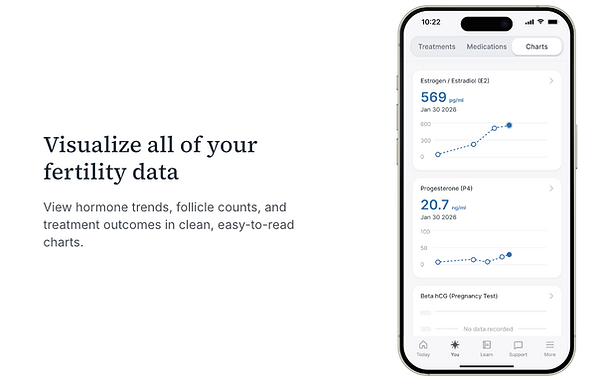
Berry Fertility focuses on supporting women along the IVF, egg freezing, timed intercourse, IUI, and FET journeys. The app's key features focus on tracking and include treatment reminders, cycle tracking, appointment management, and data visualizations of all treatment data.

Competitor Feature Matrix
Next, I developed a competitor feature matrix which includes key features under the categories of treatment navigation, emotional support, clinical and expert support, education and information and tracking and data. I also described how the feature would support women and why it might be important or not.
I ranked each feature on a scale of 1-3, 1=nice to have, 2 =important, 3=critical. My assessment of the importance of features to women was based on the secondary research review. It was important to not rank each feature the same, since some features may be more helpful than others for women. Additionally, the mere presence of a feature does not necessary mean that competitor would be "better" than another.
The highest possible score a tool would be able to receive based on my ranking was 44. Conceive came in at 27, Tilly at 26 and Berry Fertility at 17.
This matrix helped illuminate that although Conceive is "winning" in terms of key features available on the app and their overall importance to the fertility journey, the company has a gap in additional mental health/emotional support tools and tracking/data visualizations.


This competitive analysis paints the picture of what a future tool could include based on an analysis of the gaps across tools:
-
Treatment navigation tools like personalized fertility plans
-
Emotional support tools such as 24/7 coach access and peer community networks, but also journaling and mood tracking tools, meditations and breathwork exercises, among others.
-
Strong clinical and expert support such as 24/7 access with nurses and fertility expert events
-
Educational information such as injection videos to facilitate medication management and adminstration
-
Treatment tracking tools, medication reminders and data visualizations to better understand treatment data
Competitor Conclusions and Opportunity
Based on this analysis, Conceive is the only platform available on the market today that currently attempts to provide the most holistic and comprehensive tool for women navigating fertility treatment.
Existing solutions, even Conceive, offer pieces of support across the infertility journey, including treatment navigation, emotional support, expert guidance, education, and tracking. Still, these capabilities as a whole are fragmented across different tools and services. There is currently no single solution that integrates these elements into a comprehensive experience that supports both the clinical and emotional complexity of infertility.
These findings highlight an opportunity to design a more integrated support experience, one that helps women navigate both the clinical and emotional complexity of infertility in a cohesive and guided way.
Next Steps (WIP)
This project is a WIP. Next steps involve the following:
-
8 in-depth 60-minute interviews with women involving participatory activities
-
Journey map development
-
Ideation and the development of a prioritized list of platform features and opportunities based on key research insights
-
Lovable prototype for proof of concept
-
Figma prototype including homepage and two key flows highlighting features and user interaction
-
Usability testing with Figma prototype on Userinterviews.com - but I'm due with my first baby in September, so this might have to wait :)