CIRCLE
A Neurodesign Project
IDIA 740, Topics in Computers and Cognition, UBalt M.S. Interaction Design/Information Architecture
Secondary Research, Persona Creation and Prototype Development Using Lovable AI
(2026)
Project Overview
Circle is a concept I developed through my graduate course assignment in IDIA 740 (Topics in Computers and Cognition, Neurodesign) during the University of Baltimore M.S. program in Interaction Design/Information Architecture and Advanced UXR. For this project, we chose a "wicked problem" to solve for our assigned special population. I chose social media/digital media overuse and excessive screen time for children age 9-12.
This semester-long project involved the following:
-
Conducting secondary research using peer-reviewed academic literature (with synthesis assistance from ChatGPT to speed up discovery) on cognitive and emotional development in children ages 9–12, including sensation, perception, attention, memory, learning, emotion and motivation & thinking and problem solving.
-
Synthesizing insights across neuroscience, psychology, and child development research to understand how digital environments impact with the unique developmental stage of pre-adolescents.
-
Developing a concept - "Circle" designed to support healthier digital engagement through real-world exploration, creativity, and safe peer connection.
-
Building an interactive prototype using Lovable AI, translating research insights into product features informed by developmental brain science.
Secondary Research + Synthesis
Each week, we gathered articles for our special population and reviewed them to help inform our concept development. ChatGPT was heavily relied on during this stage to rapidly find recent (within last 5 years) relevant peer-reviewed articles on cognitive and emotional development in children ages 9–12, including sensation, perception, attention, memory, learning, emotion and motivation & thinking and problem solving.
Insights were synthesized across a Miro board to understand patterns, summarize findings and pull out key learnings for concept development. Yellow sticky notes signify key summaries of brain science for this group and orange sticky notes signify ideas for the concept based on the reading.

Example of Working Citation List

Example of Miro Synthesis

Example of Miro Synthesis
Persona Development
I also developed proto-personas for Circle. These personas helped frame concept development and were based on insights from the secondary research review. Each persona included basic demographic information, background summary, key details, goals, needs, digital habits and pain points.


Mid Semester and Final Deck Development
Next, I developed a deck for our mid-semester presentation that outlined the following:
-
Wicked Problem Statement
-
Ages 9-12 Brain Development Overview
-
Research on Excessive Screen Time, Digital Media and Social Media Overuse
-
Negative Effects of Screen Time/Social Media
-
Positive Effects of Digital Media Broadly
-
Positive Effects of Social Media
-
-
A Review of Competing Solutions
-
-
Justtalk, Backyard Hunt, DIY.org, Tin Can Phones
-
Below are key slides from the final presentation deck, the mid-semester deck and associated secondary research is available on request. The final presentation deck includes the following:
-
Wicked Problem Statement
-
Circle Introduction - Key Features Mapped to Brain Science
-
Persona Introductions (Sylvia and Ethan)
-
Storyboards (Quest Prep, Quest Day and Post-Quest)
-
Prototype Walkthrough Through the Eyes of Sylvia (see full deck to review)
-
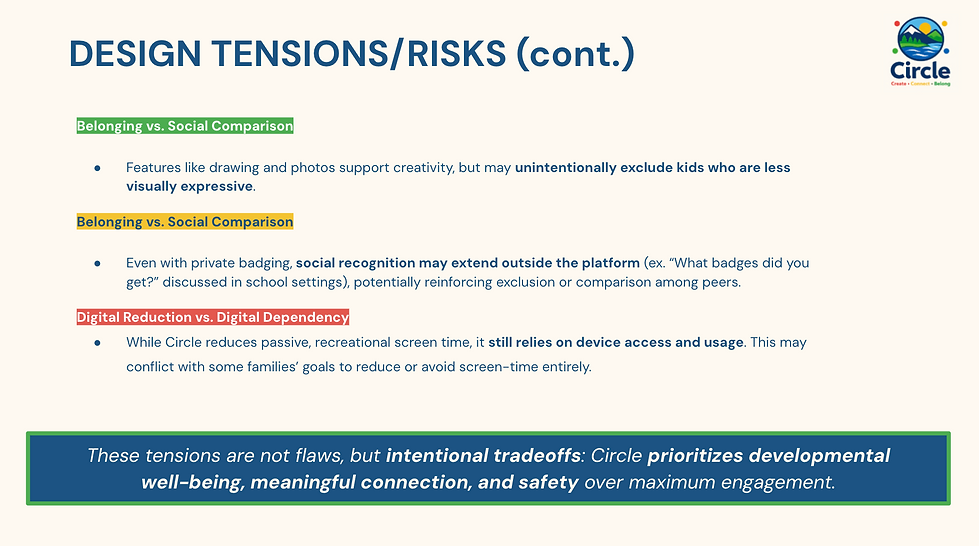
Design Tensions & Risks
Usage of AI Throughout Project
Image FX
-
I used this tool to create example images of Circle in action. These storyboards helped bring to life what using Circle would be like through the eyes of Sylvia, one of the proto-personas I developed.
Chat GPT
-
I utilized Chat GPT for assistance during the secondary research process. It sped up the process of finding peer-reviewed articles to build the case for Circle.
-
I also used Chat GPT to develop a logo for Circle.
Lovable AI
-
I used Lovable AI to develop the Circle clickable prototype proof of concept. After concluding secondary research, I took all of my feature ideas based on the secondary research and used them to create a comprehensive AI prompt for Lovable AI.
-
Lovable also assisted with developing the color scheme for the Circle logo and application.
User Flow Mapping
To develop an adequate prompt outlining screens for Circle, I first mapped the major screens and user actions across parents, children users on the app. I also included important behind-the screens app processes.
This helped me understand the screens i needed to prompt Lovable with to develop the prototype.


Final Presentation Deck - Key Slides